
February 08, 2026

Yasin Bayram
Construction Expert with 30 years of experience
What Is SPC Flooring? Layers, Benefits and the Difference from Laminate
Understand SPC flooring, its layers and practical limits. Compare it with laminate and check Kermit backing, room suitability and installation requirements.
SPC flooring is a decorative vinyl floor with a rigid core. In the classifications used by RFCI and MMFA, SPC means solid polymer core. The surface gives the floor its appearance; the core supports its structure; the selected product determines the installation method, backing and declared performance.
For a buyer, the useful question is not just “Is this SPC?” It is “Which SPC construction is being offered, for which room, and with which installation conditions?” Two floors with the same label can have different thicknesses, wear layers and backing.
What is inside an SPC plank?
Kermit's published 6 mm technical sheet provides a specific example. It shows surface treatment, a 0.50 mm wear layer, a decorative film and a rigid SPC core. The overall thickness is 6.00 mm, and this configuration has no attached IXPE backing.
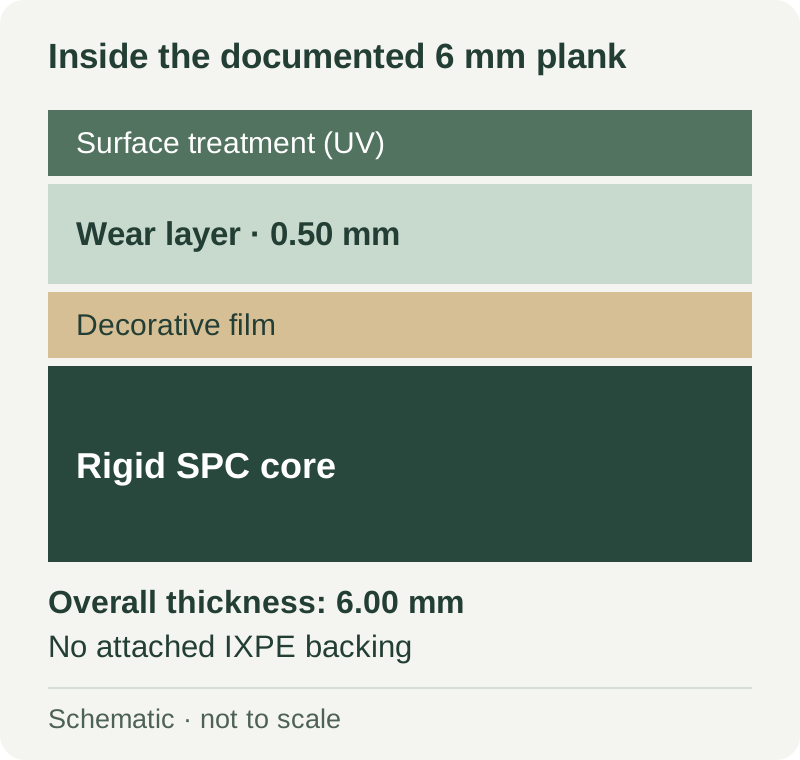
The diagram describes that configuration and is not drawn to scale. It is not a layer specification for every Kermit collection.
| Part or field | What it helps you understand |
|---|---|
| Surface treatment | The top finish described for the selected product |
| Wear layer | A separate specification from the total plank thickness |
| Decorative film | The visible wood or stone design, rather than a solid wood or stone surface |
| Rigid core | The supporting body of the plank |
| Attached backing | A product option to confirm; it is not present on every SPC floor |
| Locking system | How adjoining planks connect and which instructions apply |
Do not add wear-layer thickness to a quoted overall thickness unless the specification actually uses that convention. Likewise, check whether a stated thickness includes backing. The thickness and wear-layer guide compares these fields across the documented Kermit options.
How is SPC different from laminate?
SPC is in the rigid vinyl flooring family. Conventional laminate uses a wood-based core and a different surface construction. Both can offer decorative designs and click installation, so appearance and a click edge alone do not identify the material.
The difference matters when checking moisture exposure, care instructions, repair options and the full floor build-up. It does not justify saying all SPC is better than all laminate. Compare the actual products and their room-use instructions. The dedicated SPC versus laminate comparison covers that buying decision in detail.
SPC, LVT, WPC and “vinyl” also appear together in product searches. They are not always separate competing categories. Use the vinyl terminology guide if a quotation uses several of these names.
What are the practical benefits and limits?
A decorative SPC floor can provide a consistent specified format, a choice of surface designs and a floating click installation. Kermit's maintenance instructions use a damp cloth or mop with a suitable mild cleaner, which gives the owner a straightforward care routine. The value of these features depends on the room and the selected configuration.
The limits belong in the same decision. A rigid core does not remove subfloor preparation. A wear layer is not a scratch-proof guarantee. A water-resistant plank does not waterproof a room. Attached IXPE, where specified, does not automatically establish the acoustic performance of the complete building floor.
For example, the published 6 mm no-IXPE sheet leaves acoustics undeclared. A project needing a numerical sound result needs evidence for its actual assembly, not a number borrowed from another floor. Similarly, assess use class and any required performance against the chosen product's documents rather than the category name.
Where can Kermit SPC flooring be used?
Consider suitable indoor living rooms, bedrooms, kitchens and other temperature-controlled spaces according to the product and project requirements. Kitchens still need prompt spill removal and suitable cleaning. Kermit's guide does not recommend bathroom floors, outdoors, pools, saunas, continuously wet areas or hose cleaning.
Use the room-selection guide to compare the actual conditions. If your project includes a bathroom wall, evaluate the wall-panel system separately: flooring and wall panels are different products with different installation details. A shared SPC name does not make them interchangeable.
What does installation require?
Kermit's manual requires a firm, clean, dry base with unevenness no greater than 2 mm over 1 m. Its floating installation needs at least 10 mm clearance around walls and fixed objects, with the room layout and additional movement joints checked before work. Do not pin the floor under fixed cabinetry or through tightly fixed trims.
Heating also needs a defined system. For an approved underfloor-heating application, the maximum finished-floor surface temperature is 27°C. That is not the thermostat's water-temperature setting. Follow the heating and sunlight guide and the applicable installation document.
Before ordering, record the collection and decor, dimensions, thickness, wear layer, backing, lock, intended rooms and required documents. Compare a physical sample in the room's lighting and prepare the quantity and layout worksheet. The glossary explains the terms that appear in a flooring specification.
SPC flooring questions
What does SPC mean in flooring?
RFCI and MMFA use SPC for solid polymer core within rigid polymer flooring. For an order, confirm the complete product construction and technical sheet rather than relying on the acronym alone.
Is SPC flooring the same as laminate?
No. SPC is a rigid vinyl construction; conventional laminate has a wood-based core. Both may use decorative surfaces and click joints, but their specifications and instructions should be compared separately.
Does every SPC floor include underlay?
No. Backing is configuration-specific. Kermit's published 6 mm technical sheet describes a product without attached IXPE. Check the selected floor before specifying any additional layer.
Is SPC suitable for every wet area?
No. Kermit's flooring guide does not recommend bathroom floors or continuously wet areas. Water resistance does not replace waterproofing, substrate moisture checks or the product's room-use limits.